

Sunday, May 17, 2015


Tuesday, May 5, 2015

Monday, May 4, 2015

Thursday, April 30, 2015

Saturday, April 25, 2015

Wednesday, April 15, 2015

Tuesday, April 7, 2015
On Judging a book by its Cover- Go Right Ahead, Judge Mine

One of the lamest sayings is "You can't judge a book by its cover". It is the job
of a well-designed cover to convey a sense of why the reader should
take an interest in what the book has to say. The cover has to give us a
reason to spend our precious time (and money) with this particular
book. If a book doesn't deliver on the promise of the cover, it will
have indicted itself as untrustworthy, a self-inflicted wound at the
core of any author's most essential attribute, their credibility.
In a sense, if a cover is badly designed, it could and often does
actually function well. It's warning us the author doesn't care enough
or isn't wise enough to present his work credibly. That is a strong
signal that the book itself will be less than worthwhile. Good job, amateurish cover designers, and thanks for sparing us the effort of slogging through your badly-organized and poorly thought-through material.
Above is the cover for my book, due this Fall, about coping with
young-onset Parkinson's Disease. The publisher, Penn State Press has
chosen an image and presented it in a way that is compelling, and gives
you an idea of what to expect from the work. You will be up close and
personal with the effects of the disease. Choosing this image and
setting it against the simple background tells you we are serious. In
combination with the title, with its layered pop music reference, it
conveys the hope that there will be wit as well.
Does the content stand up to the promise? I invite you to see for yourself this Fall.
(This is a cross-post from the Alaska Parkinson's Rag)
Sunday, March 22, 2015
Coming this Fall From Penn State Press "My Degeneration" my "Graphic Novel" Memoir of Coping with Parkinson's Disease
It is official: "My Degeneration" will be published this Fall. Unlike my usual work which is normally hours, even minutes in the making, the process of going from initial concept to final images has been over three years. This is due to a number of factors, not the least being the difference in book publishing culture and newspapering. Think difference between a flash flood and a glacier.
I redrafted the initial manuscript entiely when academic publisher Penn State Press expressed interest in the manuscript. They had a number of criticisms that instantly made sense once they were voiced. Too wordy, too disorganized, and too much humor, which they believe the readers would find tiring. It also seemed to me that I needed to recalibrate the surface of the story from a scheme that initially was meant to appeal to a general comics audience to a more straightforward narrative for patients, families and medical people.
The rejiggered manuscript went over well when it went through peer review, a normal path for academic books, but a little out of the ordinary for a comic book. It could be my imagination, but interest seemed to go up after the two very positive peer reviews came back.
The momentum has quickened. The people at Penn State are hustling to get the book into their fall catalog. We are working on two possible cover designs, should have a decision on that shortly.
So the meat hits the counter soon. The fact that other people are now doing actual work on production and marketing make the whole thing seem more real, and a little more scary. It's one thing for one guy to fart around with his little story and pictures. It's another to have other people to throw in their sweat and time. I do think there is valuable content in the book for people with Parkinson's, their caregivers, families, and those who treat them in the medical-industrial complex. I hope the atypical format of comics will get that content out to to people who would not ordinarily encounter it.
Come Fall, I guess we'll see.
Here are a couple of sample pages

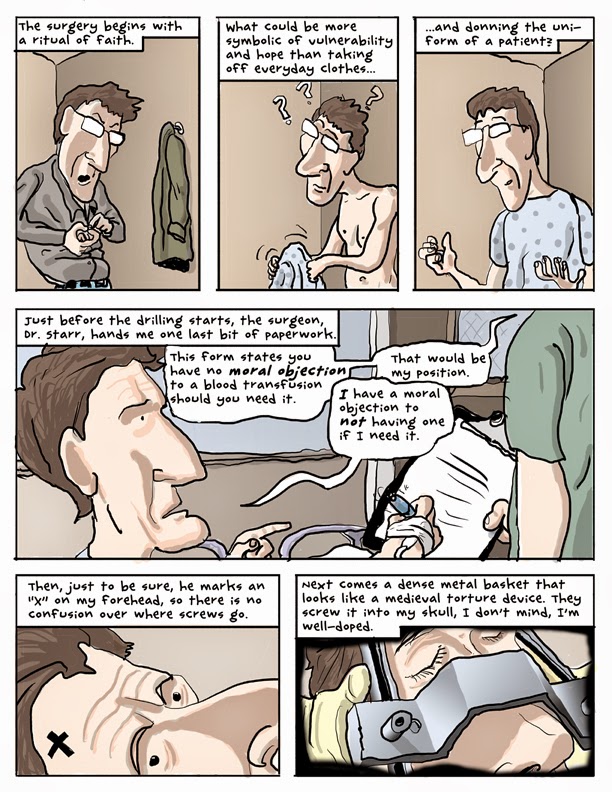
I redrafted the initial manuscript entiely when academic publisher Penn State Press expressed interest in the manuscript. They had a number of criticisms that instantly made sense once they were voiced. Too wordy, too disorganized, and too much humor, which they believe the readers would find tiring. It also seemed to me that I needed to recalibrate the surface of the story from a scheme that initially was meant to appeal to a general comics audience to a more straightforward narrative for patients, families and medical people.
The rejiggered manuscript went over well when it went through peer review, a normal path for academic books, but a little out of the ordinary for a comic book. It could be my imagination, but interest seemed to go up after the two very positive peer reviews came back.
The momentum has quickened. The people at Penn State are hustling to get the book into their fall catalog. We are working on two possible cover designs, should have a decision on that shortly.
So the meat hits the counter soon. The fact that other people are now doing actual work on production and marketing make the whole thing seem more real, and a little more scary. It's one thing for one guy to fart around with his little story and pictures. It's another to have other people to throw in their sweat and time. I do think there is valuable content in the book for people with Parkinson's, their caregivers, families, and those who treat them in the medical-industrial complex. I hope the atypical format of comics will get that content out to to people who would not ordinarily encounter it.
Come Fall, I guess we'll see.
Here are a couple of sample pages
Wednesday, March 18, 2015
Power and Creativity, A Talk Given to the Staff at the Anchorage Museum
I got a note via facebook from Anchorage Museum Director Julie Decker saying she would like me to come and give one of a series of ten-minute talks about creativity and barriers. Other speakers included Elvi Gray-Jackson, Anchorage Press Publisher Nick Coltman, Nina Kemppel, and Julie's dad Don Decker. I got to see most of the talks which were, on the whole, thoughtful and inspiring. And as a bonus, Architect John Weir played some nicely phrased music on his clarinet. My talk appears below.
Hello,
and thanks for having me. For a person who made a living over a quarter
of a century regularly giving his opinion in the newspaper, it's a
thrill to have someone actually ask for it.
Julie's initial contact message inquired how I stay motivated despite outside barriers
And Stephen wants to know how I make change.
It's
counter-intuitive, but limitations, barriers, deadlines, budgets,
whatever holds you back, are the source of creativity. No barrier, no
need to be creative. If all is going smoothly you won't have much to
inspire creativity or apply your creativity to.
Let
me illustrate with an example. Creativity is about overcoming limits.
Parkinson's Disease is about imposing them. When I reached the point in
my Parkinson's progression that it became painful for me to draw a line
on a piece of paper, I talked to my doctor. He said we had done all we
could do, he was out of ideas. He was telling me the career I loved, and
that fed my family, was over. Talk about motivating!
I
got creative. I thought about how other people at work who had
ergonomic problems had been coached to sit with their spines "stacked"
and their arms in a relaxed natural position. It occurred to me that I
could approximate this posture if I were to use an electronic tablet at a
computer. When I pitched this idea the doctor brightened and said it would work, which it does to this day.
From
there it was a simple matter of getting over my intimidation at using
the computer, and mastering photoshop to the point where I might
recreate my old paper and ink drawing style. After months of intense
frustration, bitter struggle and countless tips from my photoshop ace
wife, I finally managed it. With great pride and soaring relief I went
to the printer where my masterpiece was emerging in a volley of
electronic buzzes, clicks and beeps. And in that shining moment of
victory, in that incandescent paroxysm of pride, I realized that I had
done something truly stupid. I had just spent months turning a late
20th-Century tool, a tool that cost well over a thousand dollars, a tool
engineered with the most updated materials, and equipped with latest
powerful software, an incredible modern wonder into a simple ink pen, a
throwback to the time when monks spent their lives hand-illuminating
ancient manuscripts.
I'm all for limits, but
that was ridiculous. There was so much more that a person equipped with
such a tool could do. Color, sound and motion could all be incorporated
relatively easily into a drawing. My visual vocabulary was expanded
vastly, and my ability to express myself forcefully and precisely was
multiplied beyond what I could do with an ink pen. The barrier of pain
forced me to find a new way to make images, to create a work-around, and
that paradoxically unlocked a sea of possibilities that keep me
occupied creatively to this minute.
But let's
return to that simple ink pen for a moment and consider what such a
rudimentary, limited tool can do when attached to something powerful as
the human imagination. During the legislative tobacco wars of the 90's
the leaders of the State House refused to release a bill increasing the
tax on a pack of cigarettes from a committee where it was trapped, I did
a series of cartoons heaping scorn on the House leadership for their
intransigence. I was told by a sponsor of the bill, Con Bunde, that the
Speaker told the committee chair to let the bill go because the cartoons
had to be stopped. The bill went on to pass both houses and was signed into law by the Governor. A real Thomas Nast moment for me. Little drawings
made of old-fashioned materials proved in that instance to have more
juice than the Speaker of the House.
Was the House Speaker correct
in concluding that the cartoons had undermined her enough that her
legitimacy was at stake? Well, she was the one with the pollsters and pr
staff. I'm just a country cartoonist. What was important was that
somehow, on this point The cartoons convinced her she had to reverse
course, and she did.
This is a
tribute to the imagination. Not mine, the imagination of the House
Speaker, who saw the cartoons depicting imaginary scenes undermining her real-life
legitimacy. If she hadn't imagined some disaster from the drip, drip,
drip of ridicule pouring from my ink bottle, amplified a thousand-fold
by the ADN printing press, she never would have budged, and the bill
would have suffocated to death in committee.
This
illustrates for me a quirk of power that was identified by Hannah
Arendt, and too often goes unnoticed. The power that a person or image
has over us is largely the power we give or invest in it. If we withdraw
that power, the curtain is pulled back and the Wizard of Oz is
revealed. Think of what we call powerful imagery, even dangerous, the
homoerotic photographs of Robert Mapplethorpe, for example. Pat Robertson sees
them, and with a sudden bang, his head explodes. The next viewer is completely unfazed, by some miracle, their head remains intact. If
the power were inherent in the imagery, wouldn't everyone be damaged by
the picture? The fact is that Robertson makes his own head explode,
investing in the image a mighty power.
This also explains why religious extremists find it their duty to kill cartoonists they believe have profaned their prophet while at the same time feeling no compunction about destroying the images of the deities of others.We feel no pain at threats to the sacred beliefs of others, but are unhinged when our own are on the line.
So the way to have power to effect change is to convince, trick or seduce people into giving
you that power. The way to keep it is by proving over and over that you deserve it.
|
Thursday, March 5, 2015

Subscribe to:
Posts (Atom)